Programmatic Trends 2026

Global advertising spend is projected to rise over 5% in 2026, surpassing $1 trillion for the first time (Dentsu, 2024). This growth reflects the resilience and evolution of the digital advertising ecosystem, driven by rapid technological advancements and changing consumer behaviors.
Importantly, programmatic buying now dominates digital media, accounting for over 80% of all digital ad spend and nearly 90% of digital display spending (eMarketer, 2024). As we enter 2026, advertisers and publishers must navigate new opportunities and challenges shaped by AI, CTV, transparency and privacy-first strategies.
AI: the engine of 2026
AI will be the central engine in 2026. More than 70% of programmatic activity will be driven by AI, according to Dentsu’s agency forecast (Dentsu, 2024).
The importance of better media buying optimization, more efficient workflows, creative designs and daily decision-making processes will boost AI as a key driver in the industry. Reducing waste in data processes will help optimize campaigns, save money for advertisers and make operations more sustainable. AI will increase quality and efficiency, while humans provide a creative and ethical touch to complement pure optimization.
Transparency, trust and verified inventory
Transparency and trust are critical to avoid waste and ensure genuine user connections. The industry is searching for ways to optimize real and valuable traffic to meet demand efficiently.
Transparency in the chain, guaranteed inventory quality and clear processes are essential.
CTV growth
Streaming and Connected TV (CTV) will continue to grow. The industry will demand more accurate measurements and sophisticated programmatic media buying strategies. Interactions with ads will become more predictable on CTV, offering clients the opportunity to engage and convert.
Open programmatic CTV inventory is projected to increase by 26% next year, reflecting the rapid growth of ad-supported streaming services (Marketing Interactive, 2024).
Creative innovation for publishers
New metrics are emerging, shifting from viewability to attention, providing clients with more transparency, trust and brand safety. High-quality supply is a must: publishers with attention-based metrics will gain access to more campaigns.
Publishers need to increase revenues and monetize their supply. AI-driven creative workflows make processes more efficient and the adoption of new formats allows publishers to maximize revenue potential.
We believe in Open Web
The Open Web has significant growth potential if attention is focused on what matters most: transparency and trust. Walled gardens are becoming stronger, but the Open Web can help publishers reorganize quality inventory and reshape the programmatic landscape.
With AI and a focus on privacy, consent and anti-fraud measures, the Open Web can serve as a trustworthy and transparent partner for agencies and advertisers.
Sustainability
Sustainability will continue to be a hot topic in 2026. More accurate measurements will become a differential point. Agencies may even measure the carbon footprint of their partners, adding sustainability as a factor in programmatic media buying.
While AI is not inherently sustainable, its ethical and efficient use can reduce waste in data and bidding workflows, making campaigns more efficient and environmentally friendly.
Omnichannel era
Although modest in 2024, DOOH continues its growth, increasing around 18% annually and expanding into new geographies (Amra & Elma, 2025). DOOH is becoming a more relevant part of programmatic, representing almost half of total programmatic investment.
Audio continues growing, fueled by podcasts and streaming. Cross-channel budgets will require more accurate and trustworthy measurements.
Privacy-first environment
Privacy control is becoming more complex. In 2026, GDPR-like regulations will expand to more countries. Tech companies and publishers will need to adapt strategies based on first-party, consented data and adopt data consultancy services to prepare for this privacy-first environment.
At the same time, the goal is to deliver personalized advertising campaigns while maintaining trust and compliance.
Summary – Key Takeaways for 2026
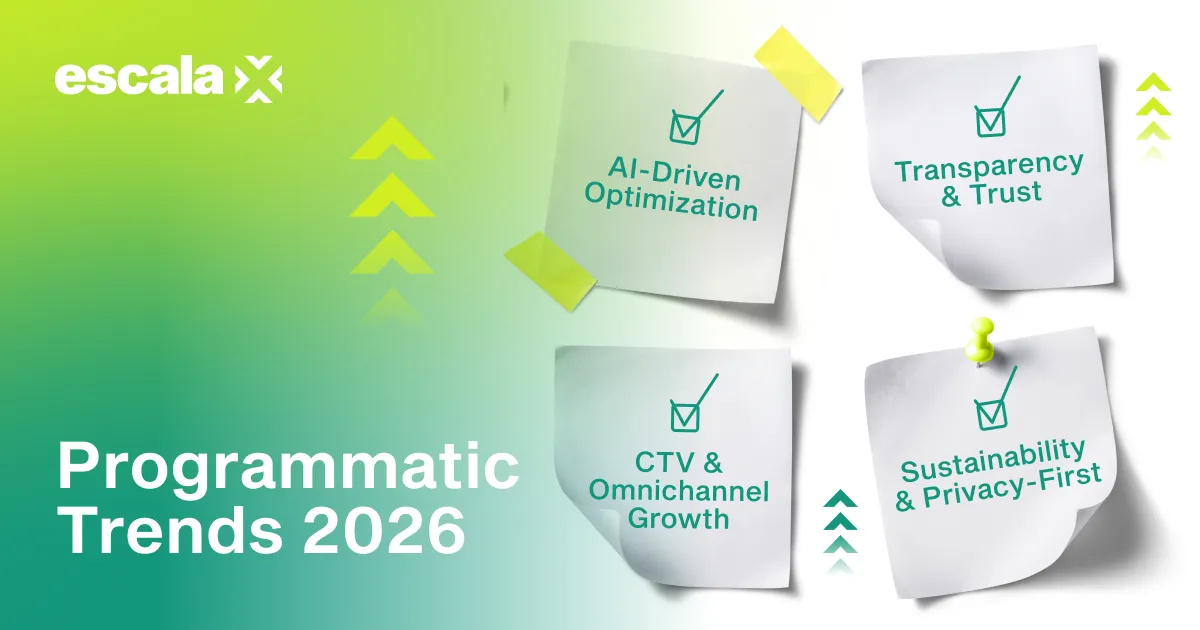
2026 marks a pivotal year for programmatic advertising. AI-driven optimization, transparency, quality inventory, CTV and omnichannel growth, creative innovation, sustainability and privacy-first strategies will define success in the digital ecosystem.
Advertisers and publishers who embrace these trends will be able to:
Optimize campaigns more efficiently while reducing waste
Engage audiences with relevant and high-quality content
Leverage emerging channels like CTV, DOOH, and audio
Operate ethically and sustainably, integrating carbon-conscious strategies
Build trust through privacy-first, consent-based data practices
At EscalaX, we empower brands and publishers to navigate these changes with intelligence, transparency and trust, unlocking better performance, stronger engagement and sustainable growth in the evolving programmatic landscape.